Most companies regularly analyze:
- office rental costs,
- energy consumption,
- software licenses,
- operational expenses.
However, organizations rarely ask themselves one important question:
How much does a single meeting in a meeting room really cost?
The answer is often far more surprising than expected.
Because the cost of a meeting is not just the employees’ time.
It also includes:
- space costs,
- technology costs,
- energy consumption,
- underutilized office space,
- organizational inefficiencies,
- poor workplace management.
In the era of hybrid work, this challenge has become even greater.
Meeting Rooms Are Among the Most Expensive Spaces in the Office
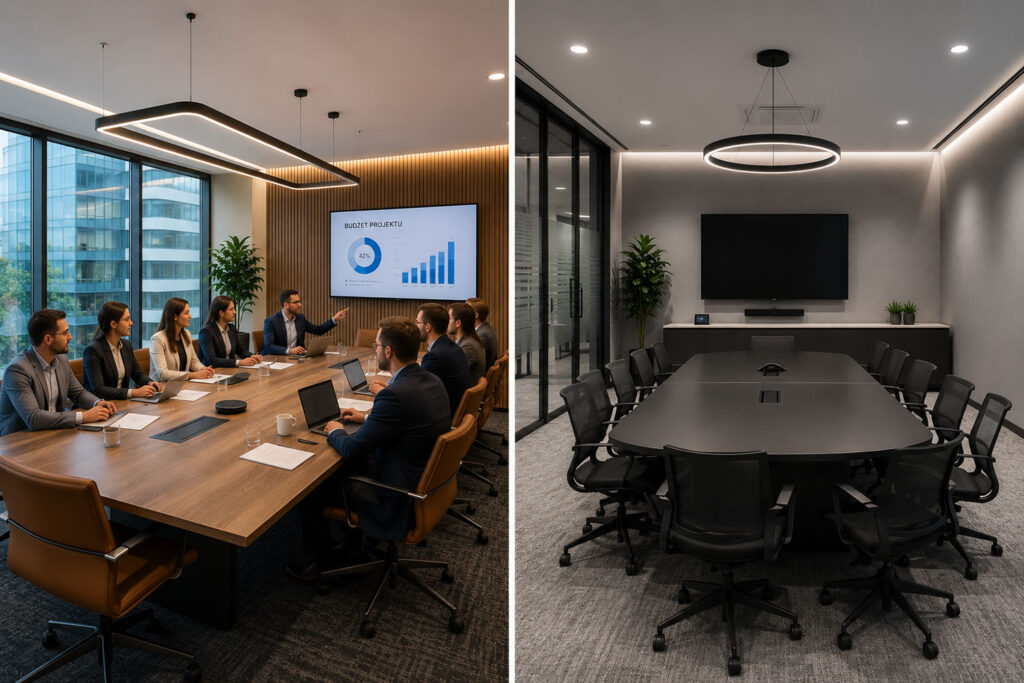
In many organizations, meeting rooms occupy a significant portion of office space. At the same time, they are among the most expensive areas to maintain.
The cost of a meeting room includes:
- rent,
- furniture and equipment,
- video conferencing systems,
- displays and monitors,
- audio systems,
- energy consumption,
- air conditioning,
- infrastructure maintenance,
- technical support,
- cleaning services.
The larger the room, the higher the operating costs. Yet many meeting rooms spend a large part of the day:
- empty,
- occupied by very small teams,
- reserved despite no meeting taking place.
Companies Often Don’t Know How Their Meeting Rooms Are Used
This is one of the biggest challenges facing modern workplaces.
Organizations frequently:
- do not analyze room occupancy,
- do not know which meeting rooms are actually used,
- do not monitor ghost bookings,
- do not measure actual room utilization.
In practice, this means companies:
- do not know how much office space they truly need,
- incorrectly assess demand for meeting rooms,
- make costly decisions without reliable data.
The result?
More office space and higher costs.
Ghost Meetings – The Hidden Cost of Hybrid Work
One of the biggest sources of waste today is the phenomenon known as ghost meetings.
These occur when:
- a meeting room is booked,
- but nobody shows up.
In practice, this creates significant inefficiencies:
- other teams cannot use the space,
- calendars appear fully booked,
- organizations assume they need more meeting rooms.
Meanwhile, the real issue is often not a lack of space but a lack of visibility into how the space is actually being used.
In large organizations, ghost meetings can generate dozens of hours of wasted room reservations every week.
How Much Can a Single Meeting Cost?
Let’s assume:
- meeting room size: 30 m²,
- office space cost: PLN 120 per m² per month,
- equipment and infrastructure investment: tens of thousands of PLN,
- energy and maintenance: ongoing operational costs.
If the room is used inefficiently:
- by small teams,
- or remains empty despite being booked,
the actual cost of a single meeting can become surprisingly high.
Especially when:
- meetings last longer than necessary,
- some participants join remotely anyway,
- the organization maintains more meeting rooms than it truly needs.
The Problem Is About More Than Costs
Inefficient meeting room utilization also impacts:
- workplace organization,
- employee experience,
- team productivity,
- the effectiveness of hybrid work.
In many organizations, employees regularly:
- struggle to find an available meeting room,
- hold meetings in open office areas,
- reserve rooms “just in case”,
- use oversized rooms for small meetings.
The result is workplace frustration and organizational chaos.
Why Traditional Calendars Are No Longer Enough
Just a few years ago, booking rooms through Outlook or Microsoft Teams was sufficient.
Today, modern workplaces require much more.
Hybrid work has forced organizations to:
- manage office space more effectively,
- analyze occupancy levels,
- monitor room utilization,
- automatically release unused meeting rooms,
- make data-driven decisions.
Without these capabilities, companies continue to operate based on assumptions.
And assumptions often lead to unnecessary costs.
How Can Companies Reduce Meeting Room Costs?
Modern Smart Office solutions help organizations:
- analyze occupancy,
- identify ghost meetings,
- monitor room utilization,
- optimize office space,
- improve meeting management.
Through workplace analytics, companies can:
- reduce underutilized meeting rooms,
- improve room availability,
- better align room sizes with actual needs,
- lower operational costs,
- enhance workplace experience.
This is why more organizations now consider meeting room analytics an essential part of workplace optimization strategies.
Do Companies Really Need More Meeting Rooms?
Very often, the answer is no.
Data consistently shows that the real issues are:
- lack of control over room reservations,
- uneven utilization of office space,
- oversized rooms for small meetings,
- lack of occupancy analytics.
In practice, many organizations already have enough meeting rooms but lack the tools and data needed to manage them effectively.
Case Study: Reducing Meeting Rooms by 17
One of our clients was preparing to relocate to a new office.
Based on previous experience and assumptions, the organization estimated that it would need 77 meeting rooms.
After implementing URVE Smart Office and applying workplace optimization mechanisms, the company was able to reduce the number of planned meeting rooms by 17.
Based on Eveo’s experience across multiple workplace projects, an average optimization factor of 35% allowed the client to confidently reduce the number of meeting rooms from 77 to 60.
This data-driven decision saved hundreds of thousands of PLN in office and infrastructure costs.
Meeting Room Costs and ESG
Unused meeting rooms generate more than financial waste.
They also create a measurable environmental impact.
Empty rooms still consume:
- electricity,
- air conditioning,
- lighting,
- technical resources.
In larger offices, this results in:
- a higher carbon footprint,
- increased energy consumption,
- greater challenges in achieving ESG objectives.
This is why more organizations are now analyzing room occupancy not only from a cost perspective but also as part of their sustainability strategy.
Summary
Meeting room costs are significantly higher than many organizations realize.
The problem is rarely a lack of office space.
The biggest challenge is the lack of reliable data about actual room utilization.
That is why modern organizations increasingly implement:
- workplace analytics,
- meeting room booking systems,
- occupancy analytics,
- Smart Office solutions.
Because the most important question today is:
How much are your underutilized meeting rooms costing your organization?
FAQ
What factors influence meeting room costs?
Meeting room costs are affected by:
- rent,
- furniture and equipment,
- energy consumption,
- air conditioning,
- video conferencing systems,
- infrastructure maintenance.
What are ghost meetings?
Ghost meetings are meetings where a room remains reserved despite no participants attending.
How can organizations analyze meeting room utilization?
The most effective approach is to use workplace analytics and Smart Office solutions that monitor occupancy and reservation data.
Can a meeting room booking system help reduce costs?
Yes. Modern room booking systems help organizations use space more efficiently, reduce ghost bookings, and improve meeting management.
Do companies really need more meeting rooms?
Often, no. The real issue is usually a lack of data and inefficient use of existing meeting spaces.
Does meeting room utilization analysis support ESG initiatives?
Yes. It helps reduce energy consumption, improve workplace efficiency, and support corporate sustainability goals.

Business Development Coordinator