Just a decade ago, the office was primarily associated with rows of desks, conference rooms, and a landline phone at every workstation. Today, we increasingly talk about intelligent workspaces that not only support productivity but also allow organizations to genuinely optimize operational costs. In this context, Smart Office solutions play a key role.
The year 2030 may seem distant, but in the world of technology, it represents just a few innovation cycles. From a board-level perspective, the key question is therefore not if, but how quickly Smart Office technologies should be implemented. What will the office look like in a few years, and which investments will deliver a measurable return on investment?
Intelligent office space management systems
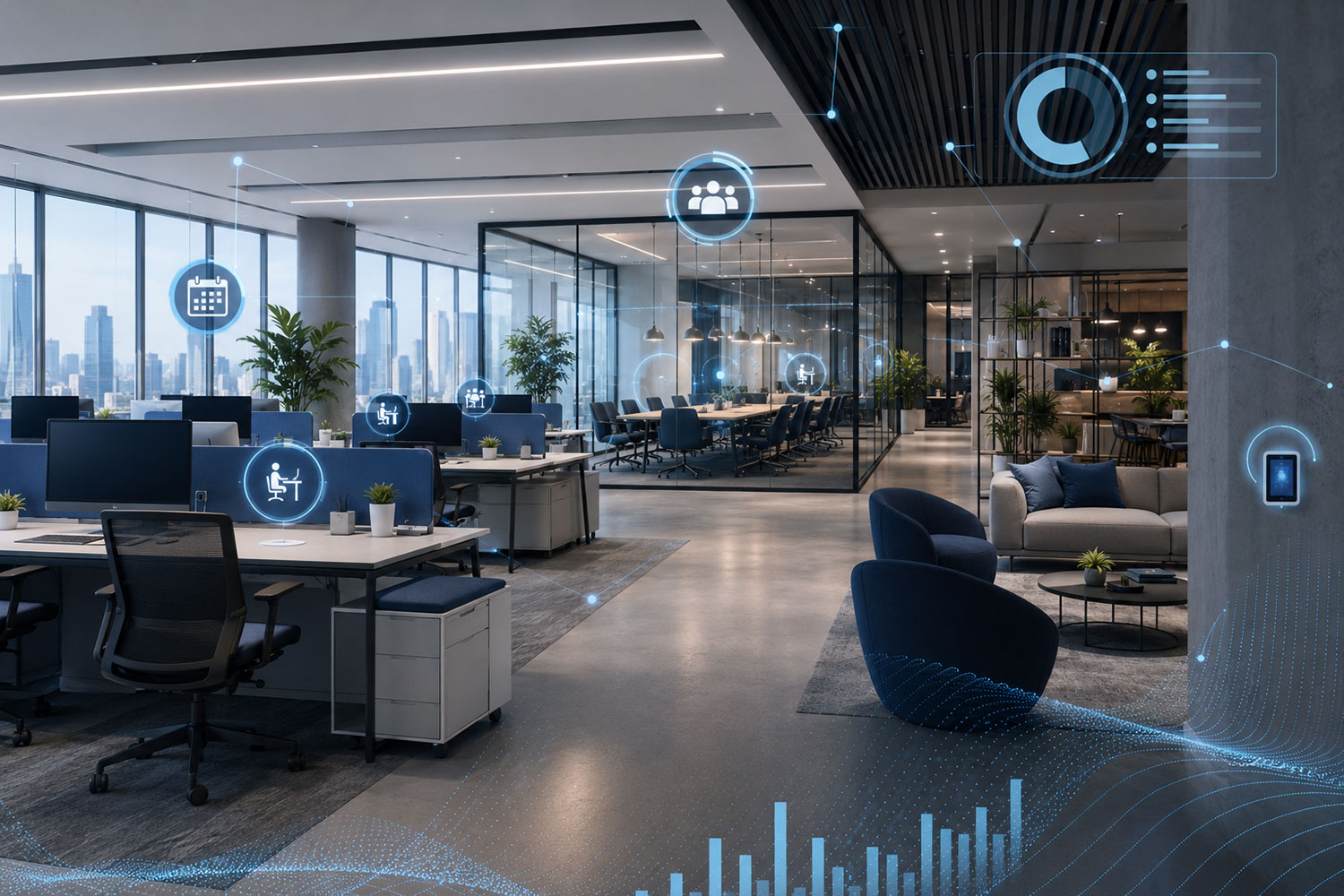
One of the foundations of the office of the future will be Smart Office systems that automatically manage space and resources.
- Room booking panels outside conference rooms (e.g., LOBO Panel), integrated with calendars and mobile apps, will become the standard.
- Interactive office maps will enable employees to quickly find an available desk, meeting room, or parking space.
- IoT sensors will monitor real-time space usage and automatically release unused reservations.
Thanks to Smart Office solutions, organizations gain full transparency into space utilization, enabling the reduction of excess office space and more effective lease cost planning.
AI and automation of office processes
Artificial intelligence already supports data analysis and communication, and by 2030 it will become an integral part of Smart Office ecosystems.
- AI assistants will automatically schedule meetings and reserve appropriate resources.
- Chatbots will handle a significant portion of HR and IT inquiries, reducing administrative service costs.
- Predictive data analytics will enable forecasting demand for space, energy, and additional services.
The result is lower office operating costs, higher team efficiency, and less manual administrative work.
Sustainable technologies and ecology as cost optimization elements
Smart Office solutions support not only ESG goals but also hard cost optimization.
- Intelligent HVAC systems controlled by AI adjust energy consumption to actual office occupancy.
- Integration with renewable energy sources helps reduce long-term costs.
- IoT systems enable precise utility consumption reporting and support ESG reporting.
A well-implemented Smart Office can significantly reduce energy and utility costs while simultaneously improving the organization’s public image.
Hybrid work and flexible offices
The hybrid work model has become the new standard, and its effective implementation today is only possible thanks to Smart Office technologies.
- Mobile-app-based hot desking allows desk reservations only when they are actually needed.
- Flexible work zones make it possible to reduce office space without compromising team comfort.
- Satellite offices can be centrally managed within a single Smart Office system.
For executive teams, this means real reductions in lease, equipment, and office maintenance costs.
VR, AR, and the metaverse as an extension of the Smart Office
By 2030, VR and AR technologies will become a natural extension of the Smart Office environment.
- VR meetings will reduce business travel costs.
- AR will accelerate training, onboarding, and technical support.
- The metaverse will become a digital extension of the office for distributed teams.
This represents another step toward scaling business operations without a proportional increase in costs.
Barrier-free offices – inclusivity supported by Smart Office
Modern Smart Offices support accessibility and diversity:
- Speech recognition and real-time captions.
- Voice control and panels adapted to different user needs.
- Automatically adjustable workstations.
For organizations, this means better access to talent and meeting growing ESG requirements.
Data security in the Smart Office environment
The development of Smart Offices requires advanced data protection.
- End-to-end encryption of communications.
- Biometrics replacing access cards.
- Predictive security systems that detect threats in advance.
Security in a Smart Office is about protecting business continuity and company reputation—not just an IT cost.
Benefits for organizations – a board-level perspective
Implementing Smart Office solutions translates into concrete, measurable business outcomes:
- optimization of lease costs through better space utilization,
- reduction of energy and utility costs,
- lower spending on office equipment,
- higher team productivity,
- better data for strategic decision-making and ESG reporting.
These are arguments that can be easily translated into ROI and investment decisions.
Summary
The Office of the Future 2030 is a Smart Office environment that actively supports an organization’s business strategy. Intelligent space management, process automation, hybrid work, and sustainable solutions allow companies to operate faster, more cost-effectively, and with greater flexibility.
For executive teams, this means cost control, scalability, and competitive advantage; for employees, a better work experience. This is the best time to begin the transformation toward Smart Office and gradually implement future-ready solutions.
FAQ – questions most frequently asked by executives and managers
Is Smart Office a cost or an investment?
Smart Office is an investment that pays off through reduced lease, energy, and administrative costs.
Where is the best place to start with Smart Office implementation?
With space management systems—reservations, panels, and occupancy analytics.
Does Smart Office work well for hybrid work?
Yes, Smart Office is a key tool for effectively managing a hybrid office.
Does Smart Office implementation require office renovation?
No. Most Smart Office solutions can be implemented in stages without interfering with existing infrastructure.